Z·04Payment Automation
Zilk ForceCharge
Charge automation between your CRM and your payment stack — with zero card data on your side.
ForceCharge bridges Whop and your CRM (GoHighLevel, HubSpot, Salesforce and more) so business events can trigger real charges: one-click bulk billing, recurring schedules with smart dunning, installment plans, and customer self-service — all inside the lowest PCI compliance scope (SAQ-A), because card data never touches your infrastructure.
Who it’s for: Businesses that run billing from their CRM and want charges automated while card data never touches their infrastructure (PCI SAQ-A).
The Zilk Difference
Why Zilk ForceCharge
01
One webhook URL per customer
Turns CRM automation events into real revenue with a single copy-paste webhook URL per customer — no custom code.
02
Lowest PCI scope
Keeps the merchant in the lowest PCI scope (SAQ-A) by never touching card data.
03
Credits before billing
The credits model lets operators bundle free usage before billing kicks in automatically.
04
Automatic and manual charging
Combines automatic workflow-driven charging and manual on-demand charging in one operator dashboard.
Capabilities
What Zilk ForceCharge does
Automatic charge triggers
Each customer gets a unique webhook URL that a CRM workflow (e.g. GoHighLevel) can POST to, charging their saved card with no request body required.
Manual on-demand charges
Charge any customer with a card on file for any amount from the dashboard, with an optional note recorded to history.
Auto customer capture
When a customer purchases, an incoming payment/membership webhook creates or updates their record with a card automatically on file.
Credits system
Give customers free trigger passes: while a customer has credits, a trigger deducts a credit instead of charging the card; once credits hit zero, charging begins.
Customer management
A dashboard of customer cards with stats, search, sort, and filters (VIP, at-risk, new, paused, no-card) plus per-customer trigger amounts and tags.
Per-customer analytics
Total charged, number of triggers fired, credits used versus charges made, and full charge history per customer.
Zero card data on your side
The payment provider stores and charges cards via API using an encrypted, server-side key that is never exposed to the browser.
Secure webhook handling
Incoming provider webhooks are signature-validated to prevent spoofing; the single-operator app protects all private routes behind authentication.
Product tour
Thirteen screens. One billing engine.
Hover to pause, click any frame to inspect it full size.
Feature slideshow
Step through every screen
A slideshow that plays on its own — click any slide to zoom in. Real product, demo data.
Customers
Use cases
Where teams put Zilk ForceCharge to work
- 01
An operator sells a package that includes a few free leads, sets a per-trigger charge amount and grants credits, so the first N automation triggers are free and every one after that charges the card automatically.
- 02
A business owner drops a customer's unique trigger URL into a GoHighLevel workflow so a business event automatically bills the customer's card.
- 03
A team charges a customer manually for a one-off amount with a note, and the charge is recorded to that customer's history.
- 04
An operator watches a live dashboard of customers, cards on file, and total revenue collected, filtering by VIP or at-risk status.
- 05
A merchant keeps card data entirely off its own systems to stay within PCI DSS SAQ-A scope while still billing on demand.
Specifications
Technical specifications
- Delivery
- SaaS web application — access from the browser; nothing to install, host, or maintain on your side
- Compliance
- PCI DSS SAQ-A — card data is stored and charged by the payment provider, never on the operator's infrastructure
- CRM integration
- Inbound webhooks from CRM automation workflows via unique per-customer trigger URLs (no body or auth needed from the CRM side)
- Payment integration
- Payment-provider REST API for card storage and charging; no direct card handling required
- Core objects
- Customers (trigger amount, credits, card-on-file, tags, total charged), trigger log entries, and charge history entries
- Authentication
- Single-operator admin login (JWT or session); all private and trigger-config routes protected; public webhook endpoints validated by signature
- Interface
- Dark terminal-style UI with green accents; responsive customer-card grid, edit panel, charge modal, and analytics panel
The story
From business event to collected revenue — five screens
Keep scrolling — the dashboard follows the story.
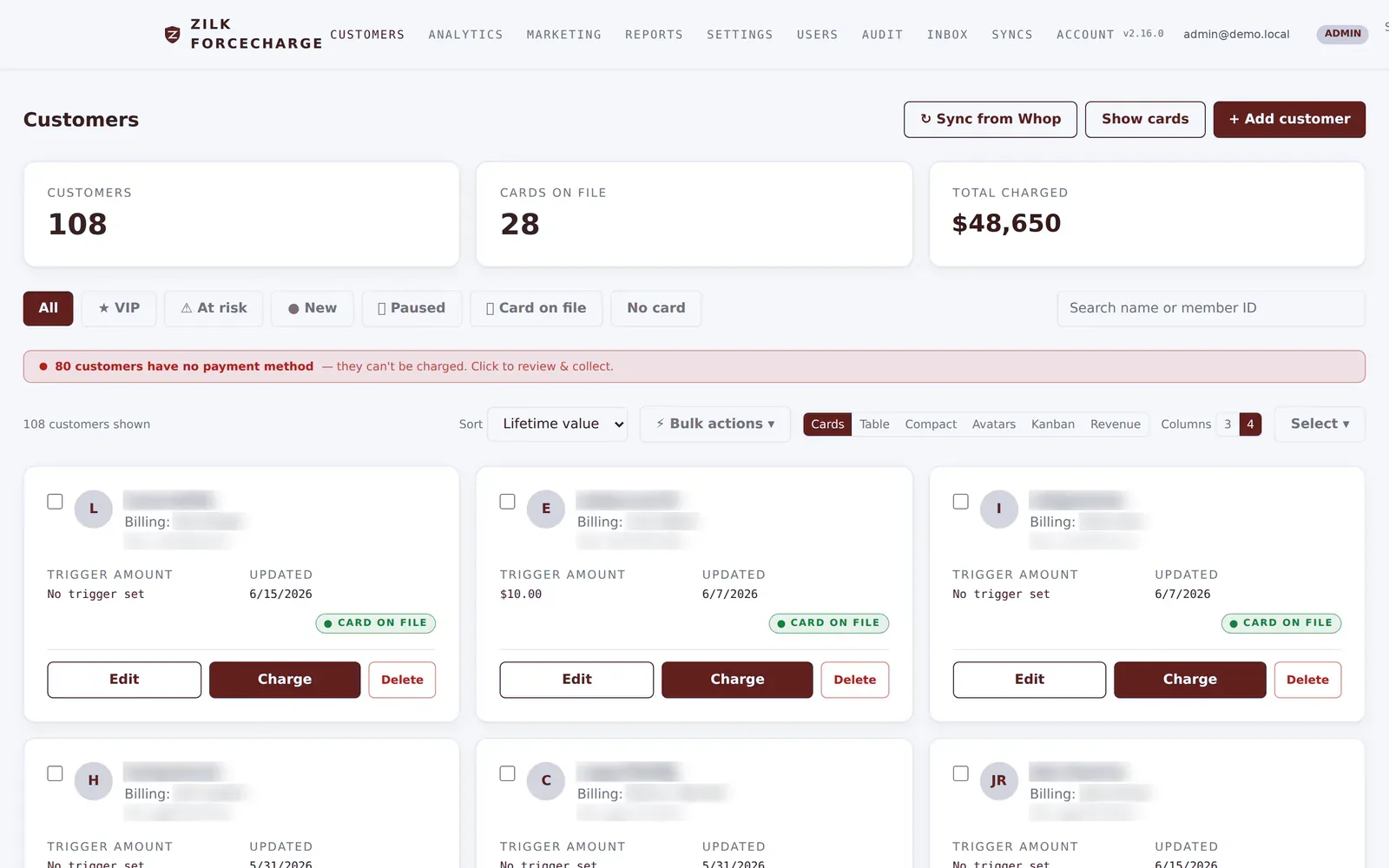
01 · Customers
Every customer, card, and charge — one screen
Customers sync in with cards on file and lifetime value; at-risk accounts are flagged for collection, and one click charges a card that never touches your infrastructure.
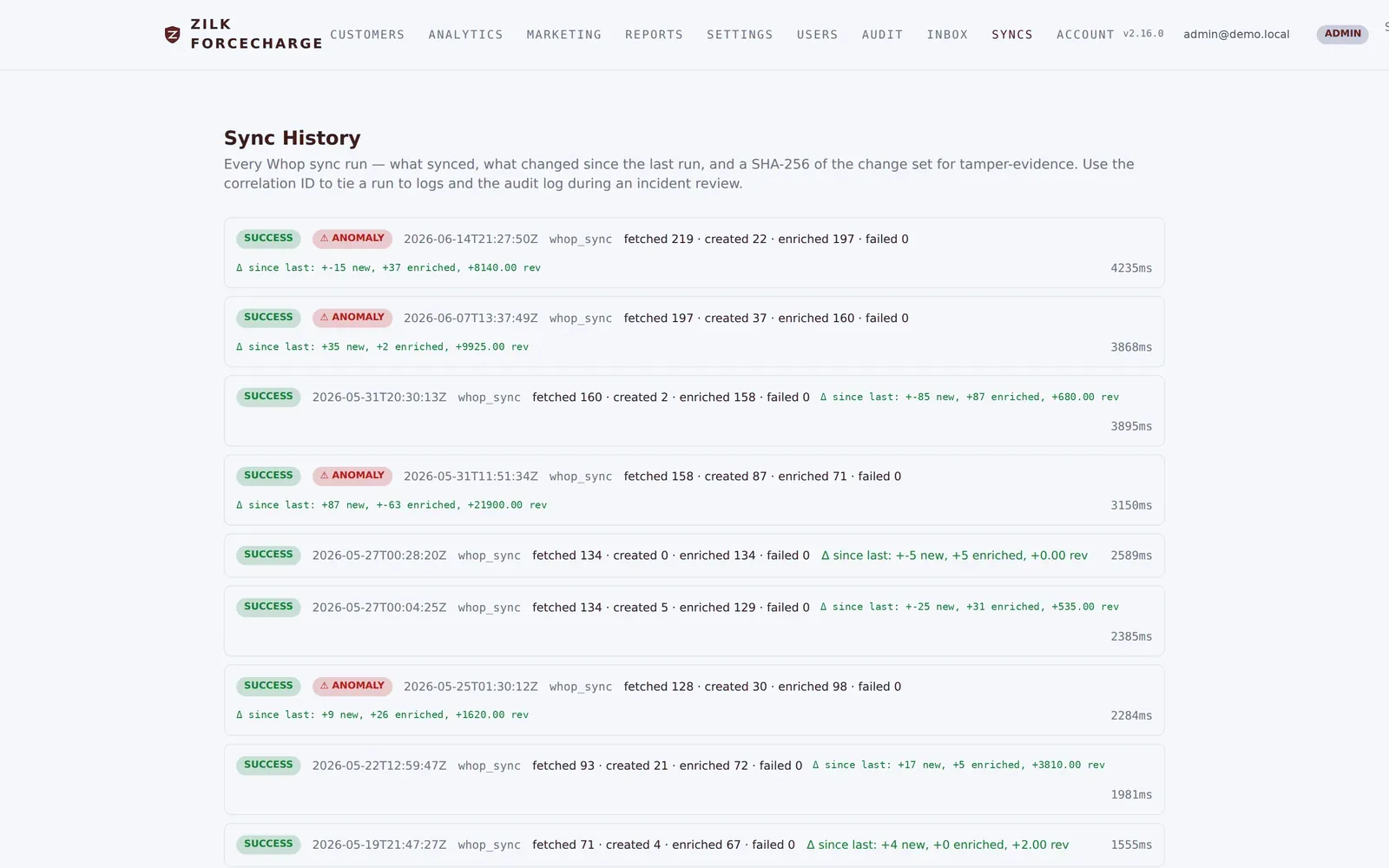
02 · Sync
One-click sync from Whop — tamper-evident
Every sync run records what was fetched, created, and enriched — with a SHA-256 of the change set and a correlation ID — so finance can trust the numbers in a review.
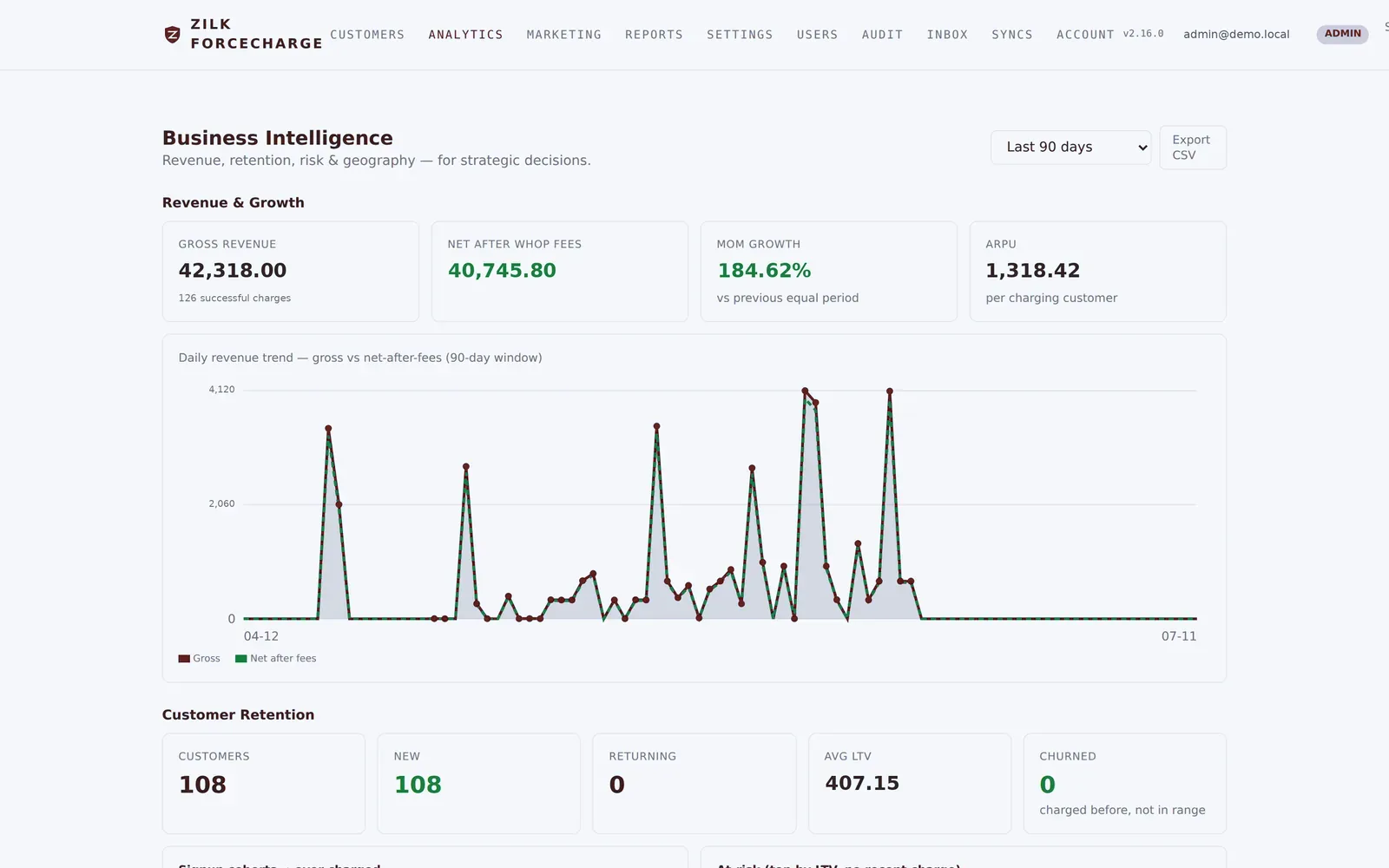
03 · Analytics
Revenue intelligence built in
Gross vs net-after-fees, month-over-month growth, ARPU, retention and churn risk — with 30/60/90-day forecasting computed on real charge data.
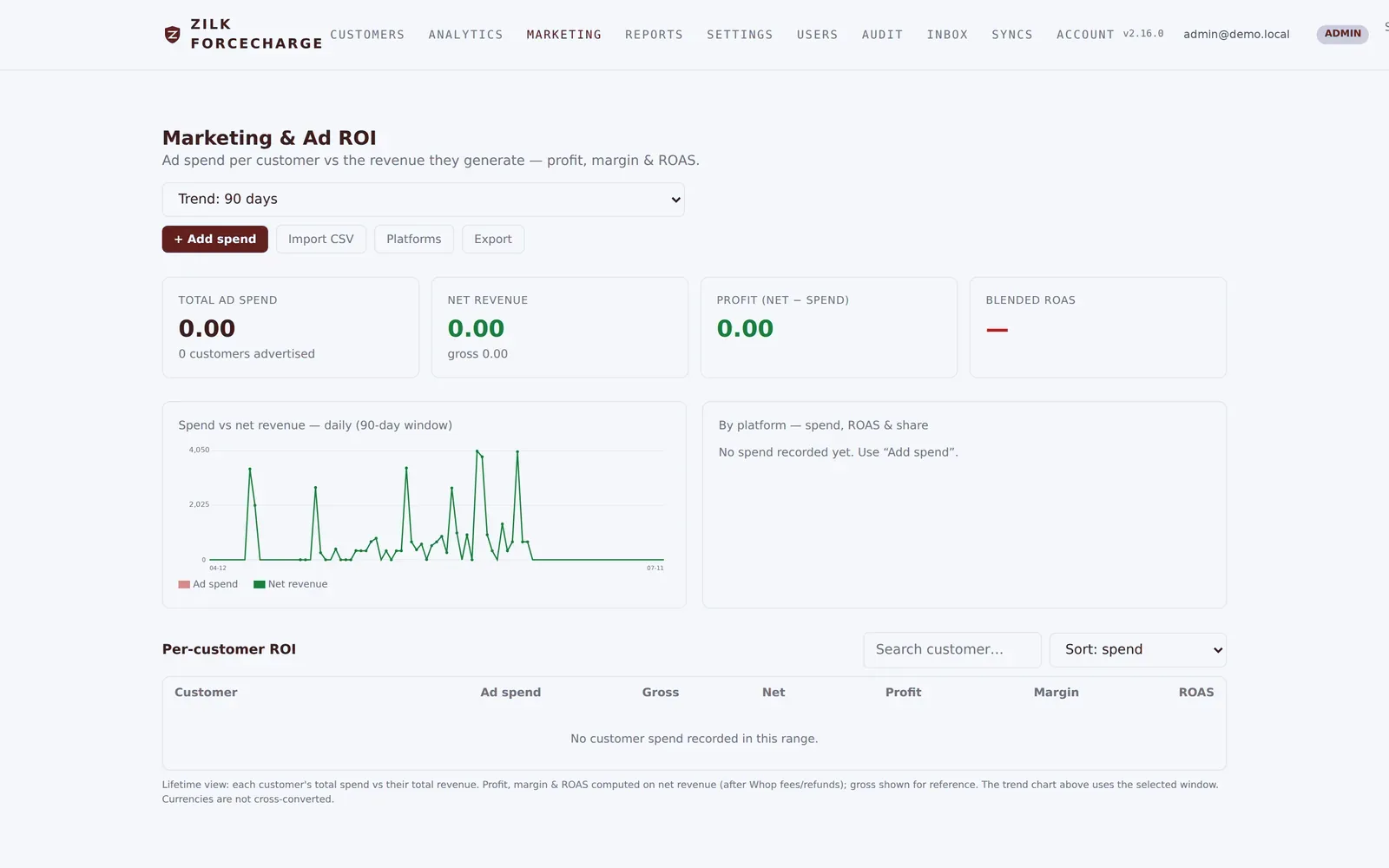
04 · Marketing
Know which campaigns actually pay
Ad and campaign ROI measured against charged revenue — spend decisions ride on money collected, not click-throughs.
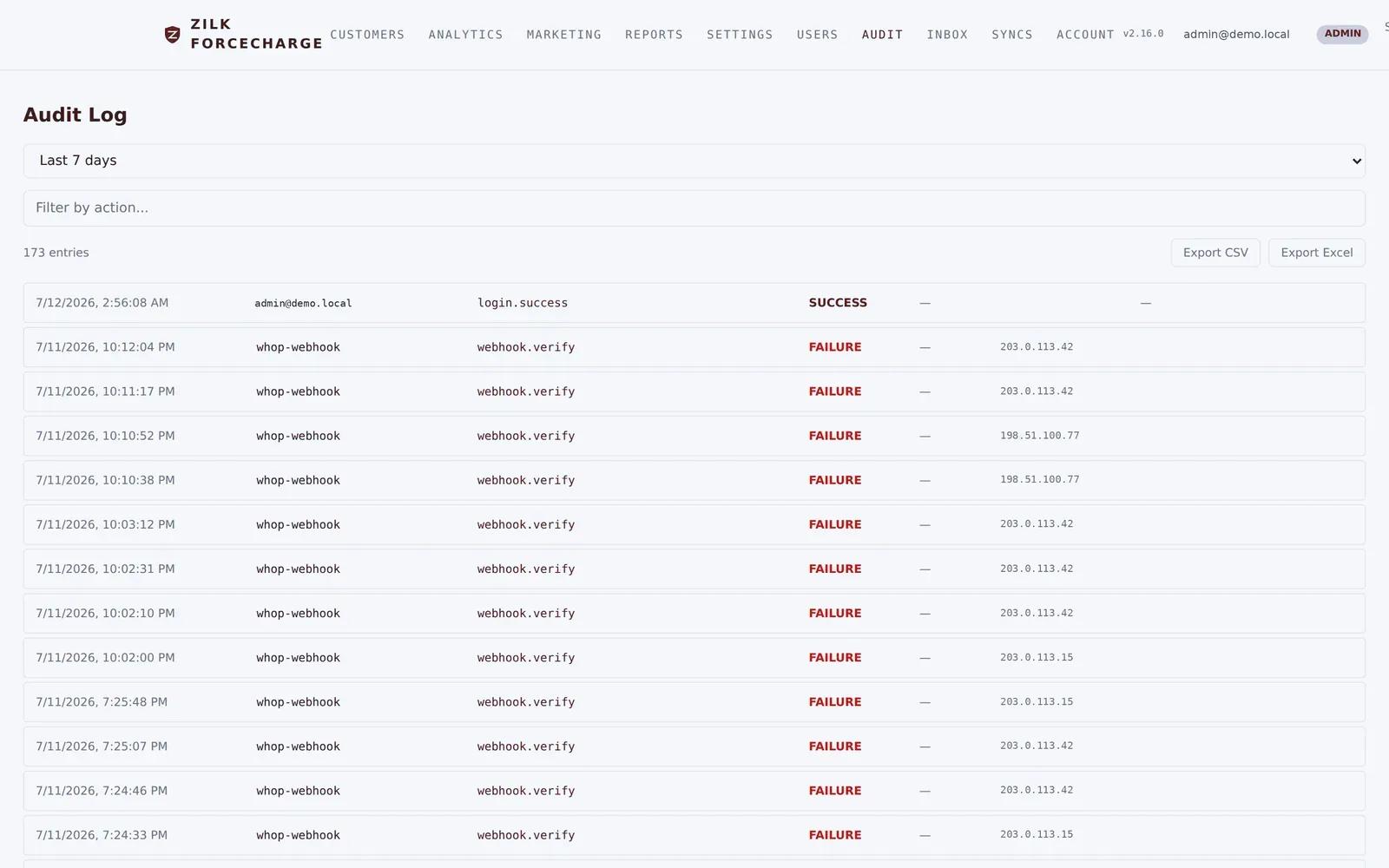
05 · Audit
Every action, on the record
A full audit trail across users, charges, and webhooks — inside the lowest PCI compliance scope there is (SAQ-A), because card data never lives on your side.
Pricing
Request pricing for Zilk ForceCharge
Tell us a little about your team and what you need — an engineer replies with pricing, typically within one business day.
Put Zilk ForceCharge to work
See it against your own environment, ask the hard questions, and get a straight answer on fit.